Too many ‘stupid rules’, too little authority: how organisations create their own red tape
- Written by The Conversation
“Dress appropriately.”
Soon after becoming General Motors’ vice president of global human resources in 2009, Mary Barra used those two words to replace a clunky employee dress code that had grown to ten pages long.
One might think that move by Barra, who now heads the company, simply signalled a return to “common sense” – meaning fewer rules and more freedom.
But in practice, “dress appropriately” actually requires something else: authority.
Employees gain more discretion, but inevitably some will get it wrong. When that happens, managers must step in and say so – a responsibility that, in General Motors’ case, some senior managers had been reportedly reluctant to exercise.
This speaks to two deeper points.
If we cede authority to people in a hierarchy – or empower them to decide what is appropriate – then we can make the rule book much shorter. And if the prospect of exercising that discretion feels uncomfortable, it suggests how unused to authority we have become.
Contemporary society, particularly in the Anglo-American world, produces rules in abundance. In this era, bosses and bossing are viewed as something of an embarrassment.
How stupid rules made for more ‘sludge’
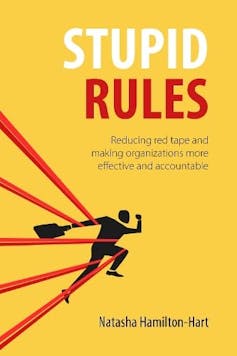
In my new book, Stupid Rules: Reducing Red Tape and Making Organisations More Effective and Accountable, I describe how a flight from authority in recent decades has stripped organisations of command capacity. This is the ability to tell others what to do without having to reference formal guidance, standards or legal rules.
I’m far from the only observer to have identified problems with the rule-heavy approach we often see taken today.
In their 2025 book Abundance, US journalists and podcasters Ezra Klein and Derek Thompson describe how land-use rules can prevent homes from being built and mire infrastructure projects in delays, rising costs and litigation.
More broadly, people struggle with red tape and pervasive “sludge” – the term used by behavioural economists for obstructive paperwork and administrative burdens.
And despite the proliferation of rules, the powerful have not been effectively restrained. Corporate lobbying has flourished and market competition has declined, as well-resourced actors have learned how to bend complex rules to their advantage.
How did we get here?
Dismantling authority was meant to make organisations more efficient and accountable. Over time, hierarchies were replaced with markets and market-like systems designed to incentivise the delivery of services such as healthcare, electricity and environmental protection.
Paradoxically, the attempt to reduce hierarchy produced more red tape. Sometimes described as neoliberal, this shift ushered in what scholars call the regulatory state.
Private markets providing services such as electricity, sewage treatment and drinking water now operate under complex rules and performance targets meant to guide their behaviour.
Yet these systems have often failed spectacularly. Each failure – whether sewage leaks, leaky buildings, healthcare scandals or other disasters – tends to trigger another round of regulation: more rules, more detailed standards and ever more elaborate performance metrics.
Is more authority the antidote?
In many cases, more detailed rules are not the answer. Organisations would often function better if they made more space for the logic of hierarchy.
Nearly a century ago, pioneering British American economist Ronald Coase explained why: firms exist because it is often more efficient to organise work through authority than through contracts and rules.
The same principle applies today. Giving decision-makers greater discretion could cut through the regulatory mire that can thwart democratically made decisions.