A Korean UV Sensor Manufacturer, Genicom Introduces Breakthrough Far UV VUV Optical Sensor for Safe and Efficient Pathogen Control
- Written by PR Newswire
SEOUL, South Korea, Jan. 31, 2024 /PRNewswire/ -- The COVID-19 pandemic is an ongoing challenge of emerging and re-emerging infectious pathogens. Ultraviolet (UV) has high energy in the wavelength range of 100 ~ 400nm and is used for sterilization, air purification, medical treatment, etc. by breaking the bond of microorganisms, bacteria, oxygen, etc.
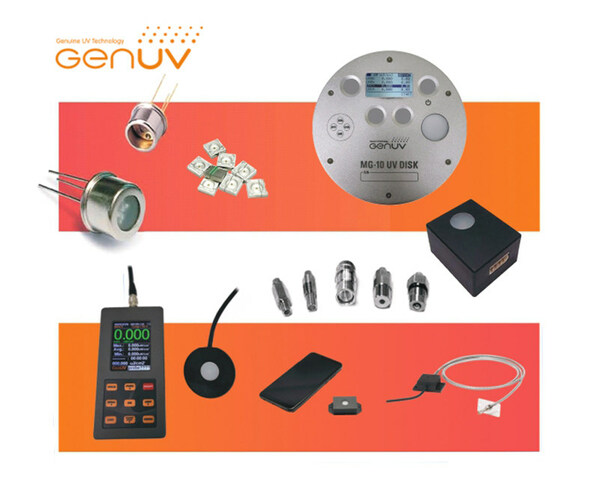 Genicom - http://www.geni-uv.com
The conventional germicidal UV light has some limitations. There has been a breakthrough, far-UV light ("far-UVC" light with a wavelength around 220 nm) cannot penetrate the dead-cell layer at the surface of our skin, nor can it penetrate into our eyes. So it can't reach or damage any living cells in our body[1]. In short, exposure to far-UVC light is safe for people, but potentially lethal for viruses in the air. Also, vacuum ultraviolet (VUV) range of 100~200nm is actively used in semiconductor fields such as photolithography and surface reforming cleaning.
As mentioned above, the need for a sensor that accurately detects only the particular wavelength range of the far UV & VUV is growing.
A Korean UV sensor manufacturer, Genicom UV Sensor Laboratory has developed a Far UV & VUV-dedicated optical sensor that can measure only the Far UV or VUV light by the AlN III-V compound semiconductor Epitaxial growth technology using high-temperature(>1300℃) Metal Organic Chemical Vapor Deposition(MOCVD).
Different from conventional Si-based sensors, the VUV sensor developed by Genicom, a Korean UV sensor manufacturer, use the nitride semiconductor with Ultra-wide band gap AlN epitaxy. It has perfect Solar-blind characteristics that are not reactive at wavelengths above 240 or 210nm due to the high crystal quality. In addition, the developed optical sensor has Photovoltaic characteristics that can detect the intensity of light source at 0V by utilizing the Schottky characteristics caused by work function difference between the light absorption layer AlN and the transparent Ni electrode. Due to the photovoltaic characteristics, the self-powered optical sensor does not require a voltage module.
The sensor consists of the TO-46 package, and the area of the absorption layer is 1.96mm2, which has a low noise characteristic with a dark current of 10pA or less.
For more details and specific information, please visit the websitewww.geni-uv.com.

Read more https://www.prnasia.com/story/archive/4321638_CN21638_0